




Reviewed by Dr. Luis Martinez, MD, Medical Director — Board Certified in Clinical Lipidology · Last reviewed: September 2026
Short answer: Wait until your weight has held steady for a stretch, then treat what’s left. Weight loss shrinks fat cells without removing them, so a pocket that outlasted the diet is exactly what non-surgical fat reduction, FDA-cleared for a BMI of 30 or less, is built for. Loose skin is a separate problem with a separate answer, covered below.
You did the hard part. The scale finally says the number you worked for — through a medically supervised program, surgery, or the long way — and yet the mirror is holding out on you: a lower-belly pocket that survived everything, a flank roll that won’t close the deal. If that’s where you are, the frustrating truth is that no amount of additional discipline was ever going to finish this. The last pockets aren’t a willpower problem. They’re a biology problem.
This guide explains why weight loss leaves those pockets behind, how to tell a fat pocket from loose skin (they need different answers), when in your weight-loss timeline contouring actually makes sense — and why the patient who just finished losing weight is, by the treatment’s own FDA clearance, exactly who non-surgical fat reduction was built for.
Quick Definitions
Subcutaneous fat — the pinchable fat layer directly under the skin; what non-invasive contouring treats.
Fat cell shrinkage — how weight loss works: your fat cells empty and shrink, but the cells themselves stay. The number of fat cells in your body is largely set by adulthood [1].
Skin laxity — looseness of skin that has lost some of its snap-back after being stretched — a skin-structure issue, not a fat issue.
GLP-1 program — medically supervised weight loss built around GLP-1 receptor agonist medication, prescribed and monitored by a physician.
BMI — body mass index. This treatment is FDA-cleared for a BMI of 30 or less, so it is the screening number your consultation checks first.
Why the Last Pockets Don’t Follow the Scale
Here’s the piece of biology that explains the whole frustrating experience: losing weight shrinks your fat cells. It doesn’t remove them. Research tracking fat tissue over time found that the number of fat cells in your body is largely established by early adulthood and stays remarkably stable after that, even through significant weight change [1]. When you lose forty pounds, billions of fat cells deflate. They don’t leave.
And they don’t deflate evenly. Where your body empties fat first — and where it holds it last — is driven by genetics and hormones, not effort. For many men, the lower abdomen and flanks are defended to the end; for many women, the same zones plus hips and thighs. That’s why someone can be genuinely lean by every measure and still carry one stubborn, well-defined pocket that ignores the deficit that shrank everything else.
This is the exact problem non-invasive fat reduction was designed for — not weight loss, but the pocket weight loss leaves behind. The treatment permanently clears a portion of the fat cells in a defined area, which diet can never do; diet only shrinks them.
Fat Pocket or Loose Skin? Two Different Leftovers
After significant weight loss — especially rapid loss — what’s left behind is usually one of two things, and they need different answers.
A residual fat pocket is volume: it’s soft but full, it rounds outward, and it’s there whether you’re standing, sitting, or lying down. This is what laser fat reduction addresses — heat disables a portion of the fat cells, and your body clears them over the following months.
Skin laxity is surface: skin that was stretched over a larger volume and hasn’t fully snapped back. It folds and drapes rather than rounding; you can gather it between your fingers as loose skin rather than pinching a full layer. Rapid weight loss makes this more likely, because skin remodels more slowly than fat empties.
Most people have some of both, in different proportions, and the proportion decides the plan. Treating a laxity problem with fat reduction removes volume the skin needed; treating a fat pocket with skin treatments leaves the volume in place.
Fat reduction addresses the pocket. Skin laxity calls for different tools: energy-based skin tightening for mild to moderate looseness, and surgical removal for the significant excess skin that can follow a large loss. Your consultation at Bogat sorts the two on your body before recommending anything. If what you mainly have is laxity, you’ll hear that plainly, along with which option fits.
When to Start: The Stable-Weight Rule
The single most useful timing rule: contour once your weight has stabilized, not while it’s still moving.
There’s a practical reason. Fat reduction shapes the layer you have on treatment day. If you’re still actively losing, the canvas is changing underneath the work — and a pocket that would have bothered you at your final weight may partly resolve on its own. If your weight is drifting up, remaining fat cells are expanding around the treated area. Either way, sessions spent on a moving target are sessions partly wasted.
For someone finishing a medically supervised weight-loss program, the natural moment is the maintenance phase: your goal weight reached — or your plateau accepted — and held steadily for a stretch. That’s when what remains is genuinely residual, and when a contouring result becomes a result you keep.
One more note for the still-losing: this isn’t a race, and starting later costs you nothing. The pockets that need treatment will still be there, and any pocket that resolves on its own is one you never have to treat.
Finishing a Weight-Loss Program — or Starting One?
Bogat offers both halves of this plan in the same practice: physician-supervised medical weight loss and non-surgical body contouring, with one team planning the sequence.
"*" indicates required fields


Why the BMI Rule Makes You the Right Candidate
Non-invasive laser fat reduction is FDA-cleared for individuals with a BMI of 30 or less [2]. Read that line as a description rather than fine print: it’s telling you who the treatment is for.
The clearance range describes a person at or near a maintainable weight, with defined pockets rather than overall volume to lose, which is a nearly exact description of the post-weight-loss patient. You’ve done the systemic work; what’s left is local. In clinical evaluation on exactly this kind of candidate, a single 25-minute session measurably reduced fat-layer thickness, by roughly 8.5% at twelve weeks, ultrasound-verified, with results building across a short series as the body clears the treated cells [3].
If you’re not inside that range yet, that’s not a closed door. It’s a sequence: weight loss first, contouring second. A practice that offers both can tell you which phase you’re in.
What a Plan Looks Like at Bogat
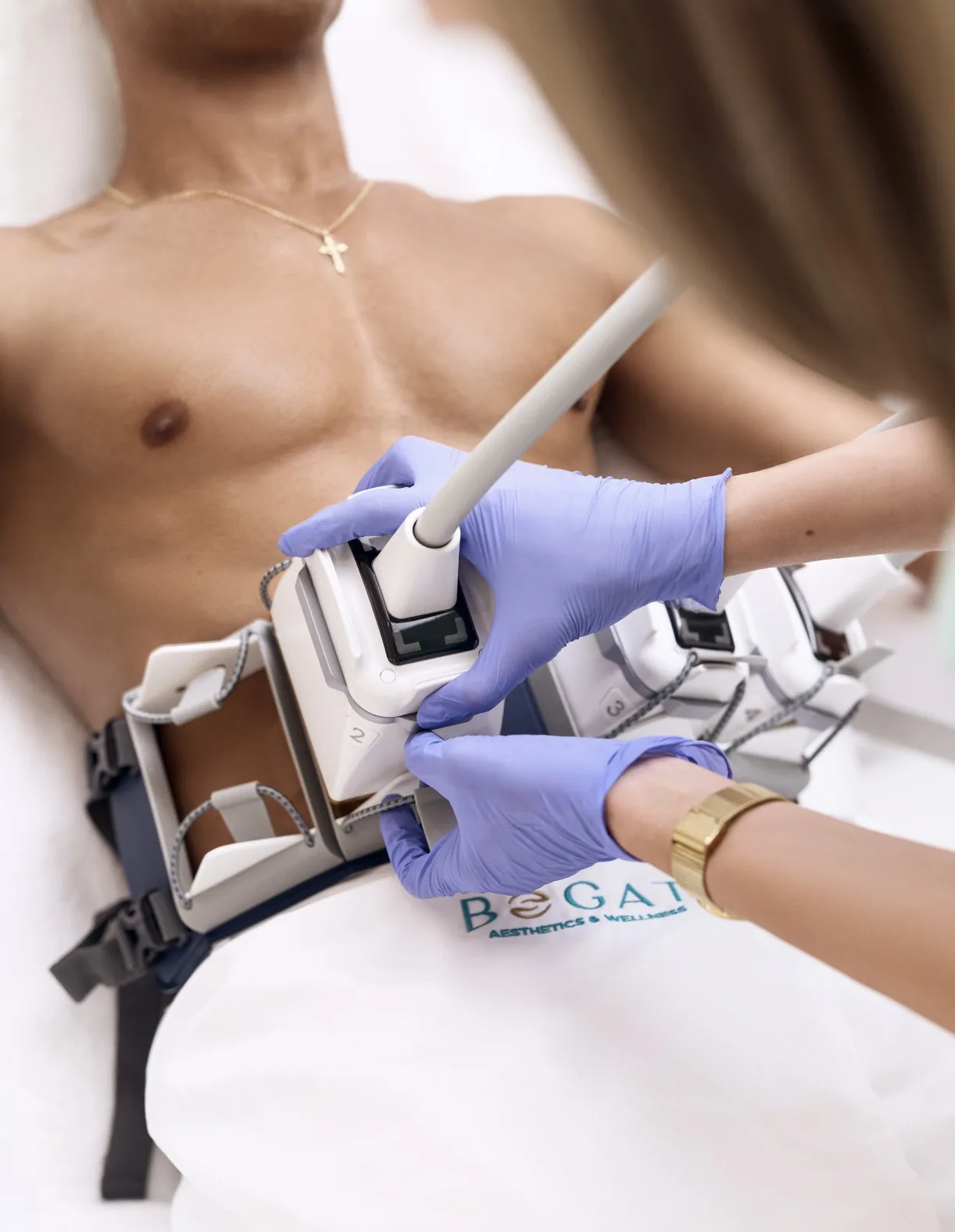
The shape of it is short. A consultation first: candidacy, the fat-versus-laxity assessment, and realistic expectations for your body. Then, for treatment, up to three laser sessions of about 25 minutes each, spaced four to six weeks apart, treating the abdomen or flanks. There’s no downtime after any of them; treatment on a lunch break is the norm.
Results follow the biology covered above: first visible change around six to eight weeks, the full contour over three to six months, and a results assessment at the end of that window. For the deeper story of what the laser does and what the studies measured, read: Does laser lipo actually work? What the evidence shows →
Body Contouring After Weight Loss FAQ
Can I start contouring while I’m still on my weight-loss program?
How long after reaching my goal weight should I wait?
Will fat reduction tighten my loose skin?
Will the pockets come back if I regain weight?
Is this different for men?
Do I have to have done a formal program to qualify?
The Recap — and Your Next Step
Weight loss shrinks fat cells; it doesn’t remove them. That’s why stubborn, genetically defended pockets can outlast every deficit. Once your weight is stable, non-invasive laser fat reduction is built for precisely what’s left: it permanently clears a portion of the fat cells in a defined area, within an FDA clearance that describes the post-weight-loss patient almost exactly. Fat pocket and loose skin are different problems with different answers, and the right plan starts with a consultation that tells them apart.
That consultation is the next step: Body Contouring & Fat Reduction at Bogat →
References
- Spalding KL, Arner E, Westermark PO, et al. Dynamics of fat cell turnover in humans. Nature. 2008;453:783–787. Read the study
- U.S. FDA 510(k) clearance K190743 for Venus Bliss — non-invasive lipolysis of the abdomen and flanks in individuals with a BMI of 30 or less. FDA record
- Kislevitz M, Wamsley C, Kang A, et al. Clinical Evaluation of the Safety and Efficacy of a 1060-nm Diode Laser for Non-Invasive Fat Reduction of the Abdomen. Aesthetic Surgery Journal. 2021;41(10):1155–1165. Read the study
This article is for educational purposes only and is not a substitute for professional medical advice, diagnosis, or treatment. Always consult a qualified provider about your individual situation.