



Reviewed by Tamriko Bogle, Laser Specialist · Clinical Aesthetician, and the Bogat Aesthetics team · Medical Director: Dr. Luis Martinez, MD · Last reviewed: September 2026
Short answer: Yes. It works measurably, modestly per session, and on a biological timeline. Ultrasound-verified studies show a real reduction in fat-layer thickness after a single treatment, and the change builds across a short series. It arrives over months rather than days because your lymphatic system, not a vacuum, does the clearing.
“Laser lipo” might be the most distrusted phrase in body contouring, and it has earned some of that. The internet uses the same three words for a surgical procedure and a non-surgical one. Marketing often compresses months of biology into before-and-after shots. And anyone who has typed the question into Google has found five confident answers that contradict each other.
So let’s answer it properly. This guide explains what non-invasive laser lipolysis does inside your body, what peer-reviewed studies measured when they tested it, why the timeline is months rather than days, and who it works for, because that’s where most of the disappointment stories start.
Quick Definitions
Laser lipolysis — “lipolysis” means the breakdown of fat. Non-invasive laser lipolysis uses laser light from outside the body to heat and disable fat cells, with no incisions.
Laser liposuction — a surgical procedure where a laser fiber is inserted under the skin to melt fat before it’s physically removed. Different procedure, same nickname — the source of most “laser lipo” confusion.
Adipocyte — the medical name for a fat cell. Your body stores fat by filling these cells, not by adding endless new ones.
Apoptosis — the orderly, natural process by which a damaged cell shuts down and is cleared away by the body.
Lymphatic system — the body’s clearing network. After treatment, it’s what collects and processes the disabled fat cells — and it works on its own schedule.
BMI — body mass index. Non-invasive laser fat reduction is FDA-cleared for a BMI of 30 or less, which is the clearest line between a good candidate and the wrong treatment.
First: Which “Laser Lipo” Are We Talking About?
Half the confusion around this question comes from a naming collision. Laser liposuction is surgery: anesthesia, a cannula under the skin, fat physically removed, real recovery time. Non-invasive laser lipolysis, which is what this article is about and what med spas mean by laser fat reduction, never enters your body. Flat applicators rest on the skin, and everything happens through light and heat.
The two get mixed together in search results, in before-and-after galleries, and in expectations. A person who reads liposuction results and books a non-invasive treatment will be disappointed. A person afraid of surgery may never learn the non-surgical version exists. Sorting this out is step one of a real answer.
How Non-Invasive Laser Lipolysis Works
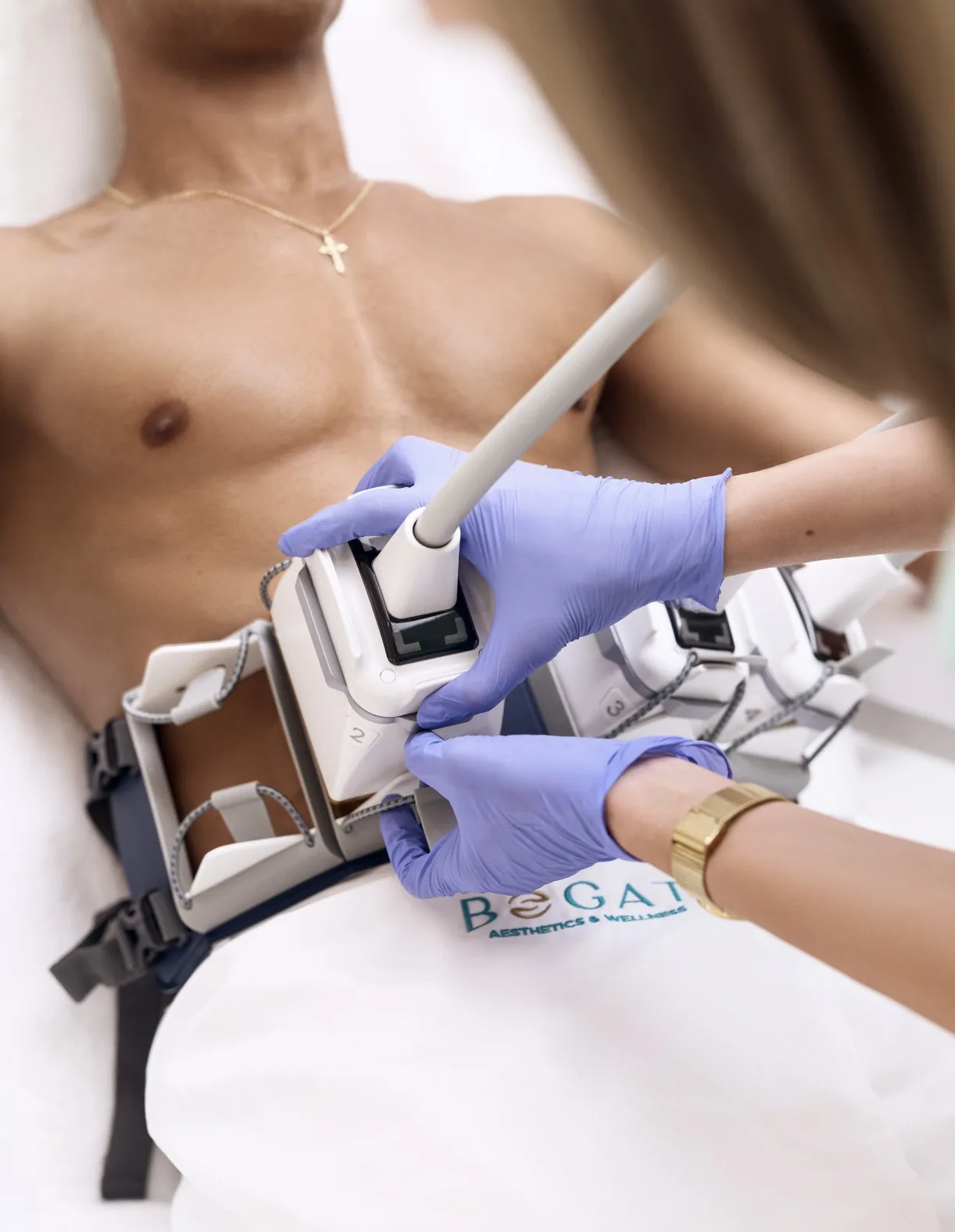
The version used at Bogat runs on the Venus Bliss™: four flat diode laser applicators, worn in a belt over the treatment area for about 25 minutes.
Each applicator emits laser light at 1064 nanometers. That wavelength was chosen because it passes through the skin’s surface and is absorbed in the fat layer underneath. The fat is gently heated to around 42–46°C, the range at which fat cells lose viability, while a water-cooling system in the applicator’s contact surface keeps your skin comfortable. The session runs in two phases: a few minutes bringing the fat layer up to temperature, then roughly twenty minutes holding it there.
Here’s the part that explains everything else about this treatment. The disabled fat cells don’t burst, drain, or leave that day. They go through apoptosis, an orderly cellular shutdown, and your lymphatic system gradually collects and processes them over the following weeks and months, the same way it clears other cellular waste. Nothing is vacuumed out. Your body does the removal, at its own pace.
What the Clinical Evidence Shows
This class of treatment has been measured in peer-reviewed clinical trials, with ultrasound rather than testimonials. Two findings matter most.
A single session produces a real, measurable reduction, and a modest one. In a two-center clinical trial of a four-applicator 1060-nm diode laser system, a single 25-minute treatment reduced the fat layer’s thickness by a mean of about 4.9% at six weeks and 8.55% at twelve weeks, measured by ultrasound. That is a statistically significant change, with no burns or blisters reported [1]. Read that number from both directions: the treatment measurably works, and one session does not remake a silhouette.
Patients tolerate it well and most are satisfied. In the clinical evaluation of the Venus Bliss platform itself, treating the abdomen and flanks, roughly three-quarters of patients reported being satisfied with their results, and average discomfort ratings sat at the low end of the pain scale [2]. In the trial above, no patient rated the pain severe [1].
Notice what those numbers imply. A measured single-session change of several percent is why a treatment plan is a short series. At Bogat that means up to three sessions spaced four to six weeks apart, with the changes compounding as clearance completes. Any promise of dramatic results “after just one session” is quoting marketing, not the measurement.
So Why Do Some People Say It Didn’t Work?
Many “laser lipo didn’t work for me” stories trace back to one of four mismatches. Not every disappointing result has a cause you can spot in advance: in the main clinical trial, roughly a quarter of participants did not report being satisfied with their result. [1]
They judged too early. The lymphatic clearance that produces the result takes three to six months to complete. At week three there is often nothing to see yet. That’s the biology working as designed, not failing.
They were the wrong candidate. The treatment is FDA-cleared for individuals with a BMI of 30 or less, treating defined pockets. It refines contour; it does not treat overall weight. Applied to the wrong problem, it will underdeliver every time.
Their weight was still moving. Fat cells that remain can still expand. A treatment done mid-weight-gain, or mid-active-loss, is shaping a moving target.
They expected liposuction. Surgery removes more fat, faster. That’s the trade. Non-invasive lipolysis trades speed and volume for no incisions, no anesthesia, and no downtime.
A good consultation screens for all four before you spend anything. That is what it’s for.

Thinking About Body Contouring?
If you have a specific area that diet and exercise won't move, a consultation at Bogat applies everything in this article to your body: candidacy, a realistic session plan, and the results you can expect.
"*" indicates required fields


What Results Look Like, Month by Month
The first weeks after a session look uneventful. Some transient redness or mild swelling the same day is common, then nothing visible for a while [1]. The change typically begins to show around six to eight weeks, as your lymphatic system works through the treated cells. The full result develops over three to six months from the end of your series, which is when a results assessment makes sense.
The change itself looks natural at every stage: a gradual smoothing and flattening of the treated pocket rather than a sudden, surgical-looking difference. That gradualness is a feature. Nobody around you sees a “procedure”; they see the gym finally paying off.
And permanence, stated plainly: fat cells your body has cleared do not come back. But the fat cells that remain can still grow with weight gain, so the result holds best at a stable weight. It is durable; it isn’t insurance against a reversal.
Who It Works For
The evidence and the clearance point at the same person: someone at or near a stable, maintainable weight, with a BMI of 30 or less, who has a specific pocket, most commonly the lower abdomen or flanks, that stays put no matter what they do. For that person, the mechanism fits the problem exactly.
It’s also why the post-weight-loss patient, including people finishing a medically supervised weight loss program, is such a natural fit. The overall weight is handled, and what’s left is precisely the kind of defined, stubborn pocket this treatment was built to address. That situation has its own guide: Body contouring after weight loss: when to start and what to expect →
Laser Lipo FAQ
How much fat does laser lipo remove per session?
Is one session enough?
Is it permanent?
Is it safe?
Does it work on darker skin tones?
Would liposuction give me better results?
The Recap — and Your Next Step
Does laser lipo work? Yes: measurably, modestly per session, and on a biological timeline. Ultrasound-verified studies show a real reduction in fat thickness. Satisfaction in clinical evaluation runs about three in four. The result arrives over months because your lymphatic system, not a vacuum, does the clearing. It works best for the right candidate: stable weight, BMI of 30 or less, and a defined pocket rather than a weight problem.
If that sounds like your situation, the next step is a consultation at Bogat in Hallandale Beach: Body Contouring & Fat Reduction →
Glossary
Adipose tissue — body fat; the tissue layer the laser targets.
Diode laser — the type of laser used for non-invasive fat reduction; at 1064 nm its light passes skin and is absorbed in fat.
Non-invasive — performed entirely from outside the body; no incisions, needles, or anesthesia.
Thermal lipolysis — fat cell breakdown triggered by sustained, controlled heat.
References
- Kislevitz M, Wamsley C, Kang A, et al. Clinical Evaluation of the Safety and Efficacy of a 1060-nm Diode Laser for Non-Invasive Fat Reduction of the Abdomen. Aesthetic Surgery Journal. 2021;41(10):1155–1165. Read the study
- Gutowski KA, et al. Clinical evaluation of the safety and efficacy of a 1064 nm diode laser, and vacuum assisted pulsed electromagnetic fields and multipolar radio frequency for noninvasive fat reduction of the abdomen and flanks. Lasers in Surgery and Medicine. 2023. PubMed
- Venus Concept. Venus Bliss™ — device and technology overview. Product page
- U.S. FDA 510(k) clearance K190743 for Venus Bliss (non-invasive lipolysis of the abdomen and flanks, BMI 30 or less). FDA record
This article is for educational purposes only and is not a substitute for professional medical advice, diagnosis, or treatment. Always consult a qualified provider about your individual situation.