


Reviewed by Ekaterina Sokolova, MSN, APRN, Board-Certified Nurse Practitioner, and the Bogat aesthetics team · Medical Director: Dr. Luis Martinez, MD, MPH · Last reviewed: September 2026
Short answer: “microneedling” now covers two treatments that look alike on a menu and behave differently on the skin. One uses a pen with fine needles. The other uses fine needles that also release radiofrequency heat below the surface.
Bogat performs both, on two different devices, and the consultation decides which one fits. This article explains what each does, where the difference shows up in results and recovery, and how that decision is made. It is the long version of the short comparison on Bogat’s microneedling page in Hallandale Beach.
Quick Definitions
Microneedling (pen, traditional, collagen induction therapy) — a motorized pen with a cartridge of fine needles makes thousands of tiny channels in the skin; the injury alone triggers collagen repair.
RF microneedling (radiofrequency microneedling, fractional RF) — needles enter the skin and release radiofrequency energy near their tips, adding controlled heat in the deeper skin to the needle injury.
Dermis — the layer under the surface where collagen and elastin live; both treatments aim here, at different depths.
Fractional — treating a grid of points and leaving the skin between them untouched, which is what keeps recovery short for both.
What Both Treatments Have in Common
Both start from the same idea. Skin repairs injury by making collagen, and a controlled, evenly spaced injury produces a controlled, even rebuild.
Both are performed after numbing cream, in a series of sessions spaced weeks apart, and both leave the skin pink or red for a day or more. Both are used for texture, pores, fine lines, and scars, and neither relies on light absorbed by pigment.
The difference is what happens at the bottom of each needle.
What a Pen Does
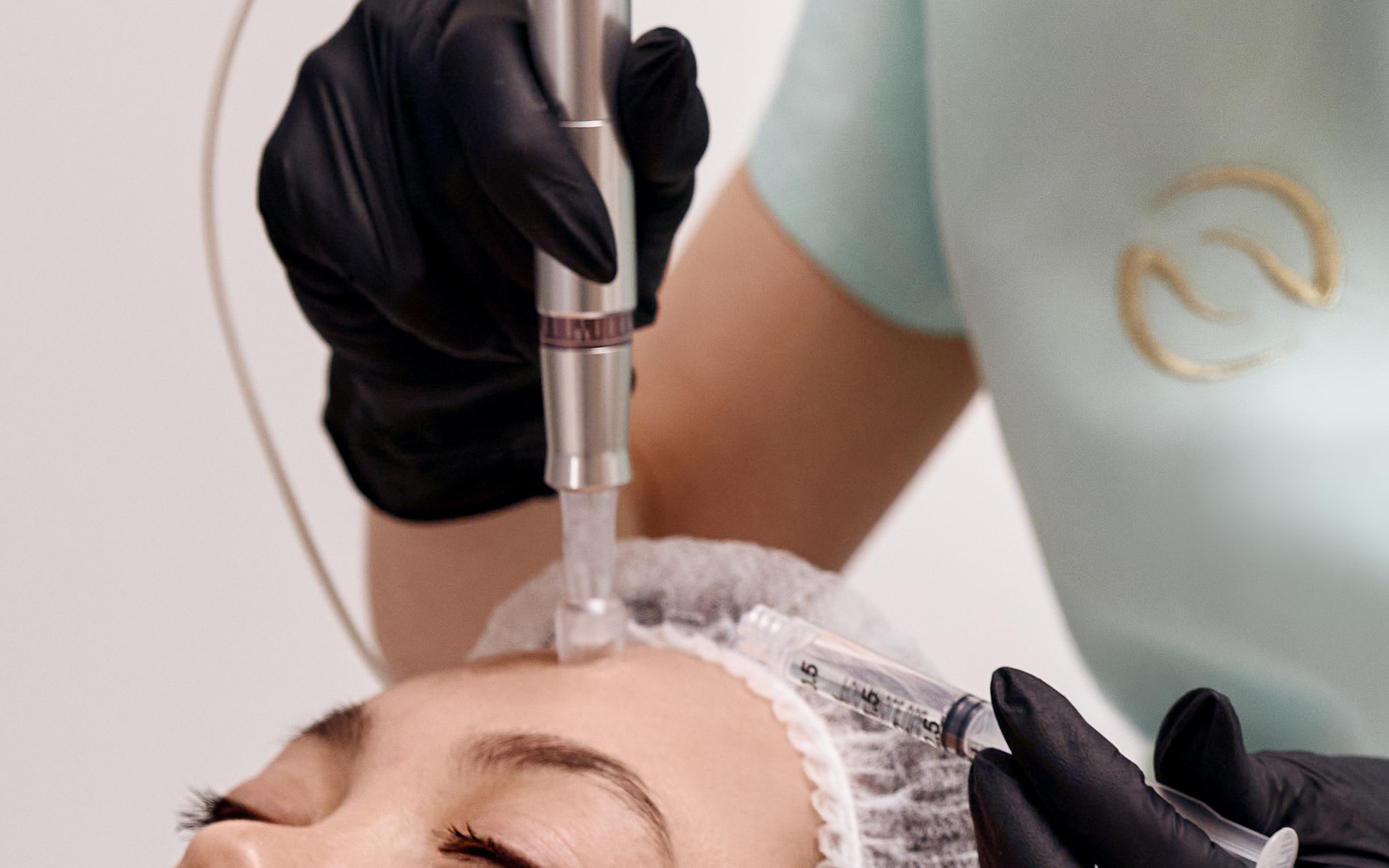
At Bogat the pen is the Candela Exceed. It carries six fine, single-use needles that move in and out at up to 150 times a second as the specialist glides it across the skin. Depth is adjusted in 0.1 mm steps, up to a maximum of 1.5 mm, shallow on the forehead and deeper on the cheeks.
Each needle makes a clean channel. The skin usually closes it within hours and, over the following weeks, lays down new collagen along it. During the treatment, as the pen creates the channels, ToskaniMED cocktails, VAMP, or the client’s own PRF are applied to the skin.
The Exceed is FDA-cleared for the treatment of facial wrinkles and to improve the appearance of facial acne scars. It is a surface-and-just-below treatment: the collagen response follows the needle injury and stays close to each channel.
What RF Adds
At Bogat the RF device is the Candela Matrix Pro. It also inserts fine needles, in a stamping motion rather than a glide, and can reach 3.5 mm at up to three depths in one insertion. The difference is that each needle is an electrode.
For a fraction of a second at the bottom of each insertion, radiofrequency current passes between the needle tips. Tissue resists the current and warms. A small zone of deeper skin around each tip is warmed enough to unravel some existing collagen, which sets off the repair response.
Because the needle shafts are insulated, that heat is released at depth and the surface stays cooler. The Matrix Pro is FDA-cleared for the treatment of facial wrinkles. The heat adds a deeper rebuilding response that a needle alone does not produce, which is why RF is the version chosen for scars and early loss of firmness.
Side by Side
| Microneedling pen (Candela Exceed) | RF microneedling (Candela Matrix Pro) | |
|---|---|---|
| What creates the change | Needle injury | Needle injury plus radiofrequency energy |
| Depth | Adjusted in 0.1 mm steps, up to 1.5 mm | Up to 3.5 mm, at up to three depths per insertion |
| Suited to | Texture, pores, fine lines, acne marks, scalp; ToskaniMED cocktails, VAMP, or PRF are applied during the session | Deeper acne and surgical scars, facial wrinkles, mild to moderate skin laxity, and skin tightening of the face, jawline, neck, and body |
| FDA-cleared for | Facial wrinkles and facial acne scars | Facial wrinkles |
| Main risks | Temporary redness, mild swelling, dryness, bruising, and sensitivity are common; pigment changes, infection, and scarring are possible but uncommon | Temporary redness, mild swelling, warmth, bruising, and dryness are common; pigment changes, burns, infection, and scarring are possible but uncommon with a trained provider. Burns, fat loss, disfigurement and nerve damage have all been reported to the FDA (October 2025 safety communication) |
| Feel during treatment | Light scratching or vibration after 20 minutes of numbing | Pressure and a moment of warmth per insertion; 4.7 on a 0–10 scale on average in the Matrix Pro’s clinical study |
| Downtime | Usually pink for 24–48 hours; makeup and exercise after 24 hours | Usually red and mildly swollen for 1–3 days, rough for several days |
| Series | 3–4 sessions, 4–6 weeks apart | 3–4 sessions, 4–6 weeks apart |
| When results show | Fresher within days; builds over weeks, full results in months | 2–4 weeks; builds for 3–6 months after the last session |
| At Bogat | Plan and pricing are personalized at your consultation; per-session prices are on the microneedling page | Plan and pricing are personalized at your consultation; see the RF microneedling page |
Prices are per session and are listed on each treatment’s own page. Most courses are three to four sessions, and the course total is quoted in writing at a complimentary consultation.
Where the Difference Shows Up
Acne scars
A pitted scar is a hole in the collagen scaffold. A pen builds collagen along its channels and improves shallow scars and post-acne marks. RF heats the base of the scar and the tissue around it, which is what deeper scars with sloping or sharp-edged walls (rolling and boxcar scars) need to lift.
Published reviews report RF microneedling on its own producing meaningful improvement in atrophic acne scars over a series. Neither treatment removes a scar.
Firmness
Heat is the reason RF is used along the jawline, under the chin, and on the neck. A pen improves the surface of loose skin without much effect on how it hangs. Reviews report a modest, real tightening from RF microneedling in mild-to-moderate laxity; significant looseness is a different conversation.
Texture and pores
Here the two are closest. Both smooth rough texture and shrink the look of pores, and a pen at shallow depth does it with the least recovery, which our day-by-day downtime guide walks through. RF is chosen when texture comes with scarring or lines that need depth anyway.
Fine lines
Both help. RF’s added heat aims for a larger change per session; both are planned as a series of three to four, and the consultation decides which fits the line.
Treatments with a serum, VAMP, or PRF
This is the pen’s home ground. Because it works shallow and fast, it is the device Bogat pairs with ToskaniMED cocktails, VAMP, or PRF applied during the session, including on the scalp for thinning hair. The pen is cleared for the needling; the add-on is Bogat’s protocol, not a cleared use of the device.

Thinking About Booking?
Bogat performs pen microneedling on the Candela Exceed and RF microneedling on the Candela Matrix Pro, both in a physician-supervised practice under the medical direction of Dr. Luis Martinez, MD, MPH. A complimentary consultation examines your skin and says which device fits, then writes the plan with sessions, spacing, and price.
"*" indicates required fields


RF Microneedling Risks, Including Fat Loss
RF microneedling carries more risk than a pen, and it deserves a plain statement. In October 2025 the FDA issued a safety communication about certain uses of RF microneedling devices, reporting serious complications including burns, scarring, fat loss, disfigurement, and nerve damage, some needing surgical repair. The FDA is still evaluating these reports with manufacturers, and it asks patients to choose licensed, trained providers and to report complications.
Fat loss is the risk people ask about most. It is listed in the FDA’s notice. The FDA’s evaluation is ongoing, and the notice neither says how often these complications occur nor attributes every case to one cause. Depth and energy at Bogat are chosen by area: the temples and the front of the cheeks on a slim face are treated shallower and cooler than the jawline, and your specialist asks about recent weight loss before setting anything. That is meant to lower the risk; it does not remove it.
Burns, scarring, and nerve effects are the other complications in the FDA’s notice. The FDA has not published how often they happen or a single cause. What Bogat controls is the setting: energy and depth are chosen for the area and skin type, the Matrix Pro reads the skin’s resistance as it works, and a first session is set conservatively.
Pen microneedling has a shorter risk list: redness, dryness, bruising, and bleeding are the expected effects the FDA lists; pigment changes, infection and scarring are possible, and the American Academy of Dermatology notes that the risk of infection and scarring rises when microneedling is done by an inadequately trained provider or with an at-home device. The FDA also notes that microneedling devices are cleared for the needling itself, not for delivering serums, vitamin solutions, or blood products into the skin; the add-ons Bogat applies are part of how the treatment is performed, not a cleared use.
For texture, pores, and acne marks, a pen series is often enough. For deeper scars, lines, and early firmness loss, RF is planned to do more per session, and the risk conversation above is part of the consultation.
How a Specialist Chooses
Choosing between traditional microneedling and RF microneedling isn’t about which treatment is better—it’s about which treatment is right for your skin. During your consultation, we evaluate your skin quality, concerns, and goals before creating a personalized treatment plan designed to achieve the best possible results.
Ekaterina Sokolova, MSN, APRN, FNP-BC
- “My skin looks rough and my pores are big.” The pen, with a ToskaniMED cocktail matched to your skin; RF only if there is scarring or lines underneath.
- “I have acne marks and a few shallow scars.” The pen, often with PRF; deeper pitted scars move to RF.
- “I have deep acne scars from my twenties.” RF, in a series of three to four.
- “My jawline is getting soft.” RF at deeper settings, sometimes with the neck in the same plan.
- “My hair is thinning.” The pen on the scalp with a hair-specific ToskaniMED cocktail or PRF.
- “I want the glow before an event.” Neither within two weeks of the event; a HydraFacial or a facial instead.
- “I want the deepest possible treatment.” A consultation. Deeper is not better; the right depth for the area is.
FAQ
Is RF microneedling better than regular microneedling?
Does RF microneedling really work?
Is microneedling safe for darker skin?
Which one hurts more?
Can you do both?
How much more does RF cost?
Recap and Next Step
A microneedling pen makes channels; RF microneedling makes channels and heats the deeper skin around them. That heat is why RF is chosen for deeper scars, lines, and early loss of firmness, and why its recovery and its risk list are both longer. For texture, pores, and acne marks, with a serum, VAMP, or PRF applied during the session, the pen is usually the right tool.
Bogat performs both. If you are not sure which fits, microneedling at Bogat in Hallandale Beach starts with a complimentary consultation that matches the device to the concern and puts the plan in writing.
Glossary
Collagen induction therapy (CIT) — the clinical name for pen microneedling: injury induces collagen.
Bipolar radiofrequency — RF current that passes between two electrodes, here between needle tips, so the heat stays in the tissue between them.
Insulated needle — a needle coated along its shaft so energy is released only at the tip, protecting the surface.
Impedance — the skin’s resistance to electrical current; the Matrix Pro measures it in real time and adjusts its output.
Atrophic scar — a scar that sits below the surrounding skin, such as most acne scars.
Laxity — loss of skin firmness; “mild to moderate” is the range RF microneedling is used for.
PRF (platelet-rich fibrin) — a concentrate spun from your own blood and applied to the skin during the treatment.
VAMP — a bottled vitamin, amino-acid, mineral, and PDRN solution made by Prollenium; not made from blood.
References
- FDA. 510(k) K240070, Profound Matrix (Candela Corporation), decision July 1, 2024: Indications for Use and clinical summary. accessdata.fda.gov.
- FDA. 510(k) K180778, Exceed Microneedling Device (MT.DERM GmbH), decision September 7, 2018 (facial wrinkles); K182407, decision July 19, 2019 (facial acne scars); K233709, Exceed Unlimited, decision February 23, 2024. accessdata.fda.gov.
- FDA. Potential Risks with Certain Uses of Radiofrequency (RF) Microneedling: FDA Safety Communication, October 15, 2025. fda.gov.
- FDA. Microneedling Devices, fda.gov, content current as of October 15, 2025.
- American Academy of Dermatology. Microneedling can fade scars, uneven skin tone, and more. aad.org (patient page).
- Niaz G, et al. Fractional Radiofrequency Microneedling as a Monotherapy in Acne Scar Management: A Systematic Review of Current Evidence. Clinical, Cosmetic and Investigational Dermatology. 2025;18:19–29.
- Kumar, et al. Radiofrequency Microneedling for Facial Rejuvenation: A Systematic Review. Journal of Cosmetic Dermatology. 2026.
- Radiofrequency and Radiofrequency Microneedling in Skin of Color: A Review of Usage, Safety, and Efficacy. Dermatologic Surgery. 2023.
This article is for educational purposes and is not a substitute for a consultation. Results vary with the concern, the settings used, skin type, and aftercare.