




Reviewed by Tamriko Bogle, Laser Specialist & Clinical Aesthetician, and the Bogat aesthetics team · Medical Director: Dr. Luis Martinez, MD · Last reviewed: June 2026
Short answer: Laser hair removal is best described as long-term hair reduction, not total permanent removal. A full series can greatly reduce hair growth, and hair that comes back is usually finer and lighter. Some people need occasional maintenance sessions — especially on the face and other hormone-sensitive areas.
Ask three different people whether laser hair removal is permanent and you’ll get three different answers: “yes, forever,” “no, it all grows back,” and “sort of.” Only one of those is close to right.
The truth is more useful than any of them — because once you understand what the laser actually does to a hair follicle, you’ll know exactly what to expect from your own treatment, session by session and year by year. Here’s the full picture: what “permanent” really means for this treatment, how the laser works, why it takes a series of sessions instead of one, and what results look like years out.
Quick Definitions
Permanent hair reduction — the FDA’s term for what these lasers are cleared to do: a long-term, stable decrease in the number of hairs that regrow after a treatment course. Note the word reduction — not removal.
Hair follicle — the small structure under the skin that a hair grows from. The follicle is the laser’s real target — the hair is the path the heat travels down to reach it.
Growth phase (anagen) — the period when a hair is actively growing. The laser only works well on hairs in this phase — which explains almost everything about session counts.
Maintenance session — an occasional top-up treatment after your initial series, used to keep results stable over the years.
What “Permanent” Actually Means (the FDA’s Definition)
Here’s the detail most articles skip: in the United States, hair-removal lasers are cleared by the FDA for permanent hair reduction — and the FDA defines that as a long-term, stable reduction in the number of hairs regrowing after a treatment regimen. Stable, long-term, fewer hairs. Not “every follicle on your body retired forever.”
That’s not a loophole — it’s just biology described plainly. A laser can permanently shut down many of the follicles it treats. But you have millions of follicles, some are resting on any given day, and hormones can wake up new ones over the years. So the realistic promise reads like this: after a full course, most clients see a substantial, lasting reduction, what regrows tends to be finer and lighter, and an occasional maintenance session keeps it that way.
If a provider tells you “100% of your hair, gone forever, guaranteed” — that’s a claim the science doesn’t support. If they tell you “nothing lasts, it all comes back” — that’s wrong too, and decades of clinical use say so.
How Laser Hair Removal Works
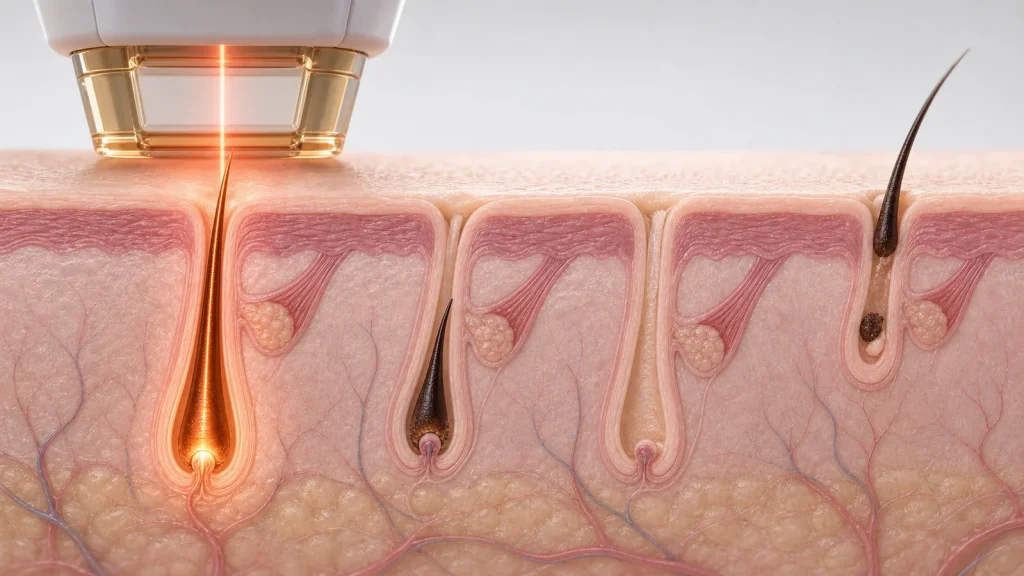
The treatment runs on one simple idea: the laser is attracted to dark pigment. Your hair is full of it — melanin, the same thing that colors skin.
When a pulse of light hits a hair, the hair soaks it up and turns it into heat in a few milliseconds. That heat travels down the hair to the follicle — the little structure the hair grows from — and damages the cells that make new hair.
The clever part is the precision: the pulse is timed so the heat builds up in the follicle, not in the skin around it. That principle (the technical name is in the glossary below) is what won this treatment its place in dermatology in the 1990s, and it’s been there since.
A follicle hit while its hair is actively growing is much less likely to produce visible hair long term. Which raises the obvious question: if the laser is that effective, why does treatment take a series of sessions?
Why Many Plans Take 6–8 Sessions (the Hair-Cycle Math)
Every hair on your body takes turns: it grows for a while, winds down, rests, and sheds — then the cycle starts again. The laser only reliably shuts down a follicle while its hair is in the growing phase, because that’s when the hair is connected to the follicle and full of pigment, so the heat lands exactly where it needs to.
Here’s the catch: at any moment, only some of your hair is growing. The share varies a lot by body area — on the legs, most hairs may be resting at any given time. The laser largely passes resting follicles by.
So one session can only catch the follicles that happened to be growing that day. The next session — four to eight weeks later — catches the next wave as it starts growing. Six to eight sessions is simply how long it takes for most of your follicles to take their turn while the laser is there to meet them.
This is also why session spacing isn’t arbitrary, and why “more sessions sooner” doesn’t work: you can’t treat a follicle that isn’t growing yet. The schedule is the treatment.
What Results Look Like, Year by Year
During your series (months 1–6): after the first session or two, treated hairs shed and regrowth comes in visibly slower, finer, and patchier. By mid-series, most people are shaving occasionally rather than constantly. By the end of a full course, the reduction is substantial and holds.
The first year after: results from a completed series are at their best — smooth skin with sparse, fine regrowth at most. Published clinical reviews report substantial long-term reductions after a full course, with results varying by area, hair color, and individual biology — which is why a good provider gives you a range at consultation, not a promise.
Years later: follicles that were fully treated generally stay quiet — but your body isn’t a fixed system. Hormonal shifts (pregnancy, menopause, conditions like PCOS, some medications) can wake up new hair, particularly on the face, chin, and neck. That’s not the old hair “growing back” — it’s new production from follicles the laser never treated. One or two maintenance sessions when regrowth appears — for many people once a year or less — keep the result where the original series left it; hormonal changes and individual hair cycles vary.
The pattern worth remembering: body areas (underarms, legs, bikini) tend to hold long-term results best; hormonally sensitive facial areas are the most likely to need maintenance. A good provider tells you this upfront and plans for it.
Ready to Start Your Laser Hair Removal?
Fill out the form and our team will help you plan your series and answer any questions — no obligation.
"*" indicates required fields


What Affects How Permanent Your Results Are
Four factors do most of the work:
Hair color. The laser targets pigment, so dark hair responds best. Blonde, red, gray, and white hairs lack the melanin to absorb the energy — laser isn’t the right tool for them, no matter how many sessions anyone sells you.
Hair thickness and area. Coarse, dense hair (underarms, bikini) absorbs energy well and tends to clear impressively. Fine vellus hair responds less.
Hormones. The single biggest driver of regrowth over the years, especially on the face. This is also why your consultation should include questions about your history — it changes the forecast.
Completing the series with correct settings. Sessions cut short, stretched too far apart, or treated at overly cautious settings catch fewer anagen follicles. The technology matters here too — wavelength matched to your skin tone is what allows effective (not just safe) energy levels. That’s a conversation for your consultation at Bogat.
Laser vs. Electrolysis: the “Truly Permanent” Question
Electrolysis is commonly described as permanent hair removal — a stronger claim than laser’s “permanent reduction” — because it destroys follicles one at a time with a fine probe and an electrical current, and it works on any hair color, including the blonde and gray hairs laser can’t treat.
The trade-off is scale: electrolysis treats one follicle at a time, which makes it excellent for small areas and light-colored hairs, and impractical for legs, backs, or anything large. Laser treats hundreds of follicles per pulse. For most people with pigmented hair, the practical answer is laser for the bulk of the work, with electrolysis as the finisher for stray light hairs, if needed. The two aren’t rivals so much as different tools.
Frequently Asked Questions
Why is hair still appearing two weeks after my session — did it not work?
Can laser hair removal make hair grow MORE?
I plucked between sessions — did I ruin my results?
Does hair grow back after laser hair removal?
Can hair come back years later?
Is laser hair removal permanent on the face?
Why do results vary so much between people?
Is there anything that makes results last longer?
Recap & Next Step
The short version in three lines: laser hair removal delivers permanent hair reduction — a long-term, stable drop in regrowth, as the FDA defines it — not the erasure of every follicle forever. It takes six to eight sessions because the laser can only shut down follicles while their hair is growing, and your hair takes turns. Most people keep a substantial, lasting result with occasional maintenance, and the face needs more upkeep than the body.
If you’re in South Florida, Bogat Aesthetics & Wellness performs laser hair removal in Hallandale Beach on the dual-wavelength Candela GentleMax Pro Plus, with plans matched to your skin tone and hair, and realistic session forecasts at consultation.
See how it works at Bogat, the areas we treat, and book a consultation →
Glossary
| Term | What it means |
|---|---|
| Anagen / catagen / telogen | The three phases of the hair cycle: growing, transitioning, resting. Lasers work on anagen hair |
| Melanin | The pigment in hair and skin that absorbs the laser’s light and converts it to heat |
| Selective photothermolysis | Heating a chosen target (hair pigment) with a wavelength and pulse length that spare surrounding tissue |
| Permanent hair reduction | FDA-cleared claim: long-term, stable reduction in the number of regrowing hairs after a treatment course |
| Vellus hair | Fine, lightly pigmented “peach fuzz” — responds poorly to laser because it carries little melanin |
References
- U.S. Food & Drug Administration — 510(k) clearance summary, long-pulsed Alexandrite & Nd:YAG hair-removal laser (defines “permanent hair reduction” as the long-term, stable reduction in the number of hairs regrowing measured at 6, 9, and 12 months after completing a treatment regime)
- American Academy of Dermatology — Laser hair removal: FAQs
- Mayo Clinic — Laser hair removal
- Gan SD, Graber EM. Laser hair removal: a review. Dermatologic Surgery. 2013;39(6):823–838. PubMed
- Anderson RR, Parrish JA. Selective photothermolysis: precise microsurgery by selective absorption of pulsed radiation. Science. 1983;220(4596):524–527. PubMed
- Candela Medical — GentleMax Pro Plus platform documentation
- Gender Disparities in Paradoxical Hypertrichosis After Laser Hair Removal (incidence reported ~0.6–10%). PMC
This article is for educational purposes and is not a substitute for a consultation. Your results depend on your hair, skin, and history — a qualified provider should evaluate those before treatment.