

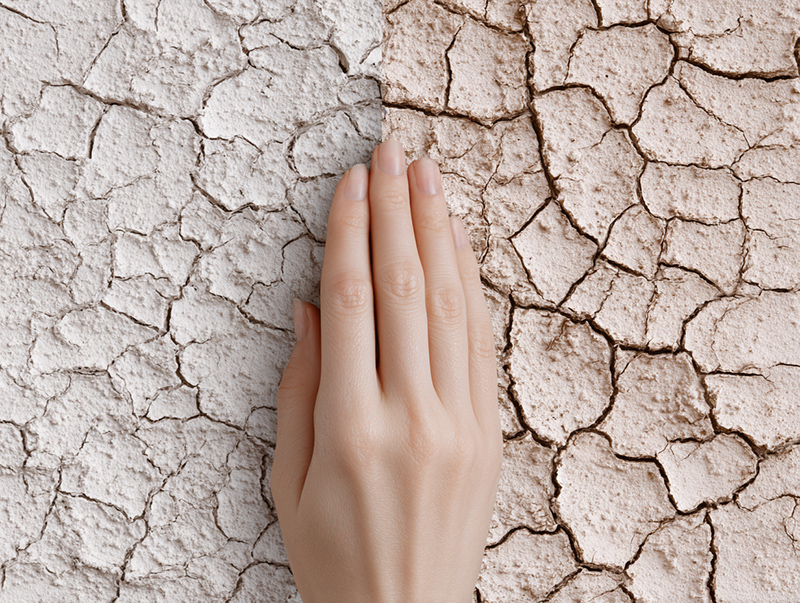


“Dry” and “dehydrated” get used interchangeably—but they’re not the same, and the fixes are different.
Educational content only: if you have persistent inflammation, cracking, open sores, or worsening symptoms, see a dermatologist.
Quick Definitions
Dry skin = low oil (lipids).
Often a skin type: your skin naturally produces less oil, so it struggles to protect itself and tends to feel rough or flaky.
Dehydrated skin = low water.
A skin condition: any skin type (even oily) can become dehydrated when water content is low or the barrier is stressed. [1]
A Biologique Recherche way to say it: dehydrated = lack of water, while “true dryness” (undernourished) = chronic lack of lipids, where water alone won’t be enough. [6]
Mini takeaway
- Hydrating = adding water
- Moisturizing/nourishing = replenishing lipids + sealing water in
What’s Happening in Dry vs Dehydrated Skin
Dry skin (low lipids)
Your skin’s protective layer (hydrolipidic film/barrier) is short on lipids. That makes it easier for water to escape, leaving skin rough, tight, and more reactive.
Common signs
- Rough texture, flaking, or scaling
- Itchiness or irritation
- Skin feels “under-protected” or easily uncomfortable
Common triggers
- Cold/dry weather, indoor heating/AC
- Long/hot showers
- Harsh soaps or frequent cleansing
- Age-related changes (skin naturally produces less oil over time)
Dehydrated skin (low water)
The upper layers of the skin aren’t holding enough water—often because the barrier is stressed or your environment is drying (low humidity, travel, over-cleansing, too many actives). [1]
Common signs
- Tightness—especially right after cleansing
- Dullness; fine lines look more noticeable
- Makeup looks “cracked” or patchy
- Sometimes: a “tired” look
Common triggers
- Over-exfoliation or stacking strong actives
- Hot showers and stripping cleansers
- Low-humidity environments (air travel, winter air, AC)
- Using hydrating products but not sealing them with a moisturizer
Can you have both at once?
Yes—and it’s extremely common. A barrier that’s short on lipids can also struggle to hold water, so skin can feel tight and look flaky at the same time. [1]
How to Tell the Difference (At Home)
These aren’t diagnostic tools, but they can give useful clues.
Pinch test (dehydration clue)
Gently pinch skin (cheek or back of hand). If it takes longer to bounce back, dehydration may be more likely. [1]
Note: with mature skin, bounce-back can also be slower due to natural age-related elasticity changes—use the post-cleanse check as your backup. [11]
Post-cleanse check
- Tight immediately after cleansing → dehydration/barrier stress is more likely
- Consistently rough/flaky regardless of products → true dryness is more likely
Dry vs Dehydrated at a Glance
(Based on common signs and “tell the difference” guidance.) [1]
| What to look at | More likely dry skin (low oil/lipids) | More likely dehydrated skin (low water) |
|---|---|---|
| Core difference | Lacking lipids/oil | Lacking water |
| How it feels | Rough, can itch; “under-protected” | Tight/uncomfortable, often after cleansing |
| How it looks | Flaking/scaling, irritation | Dull; fine lines more visible; can look “tired” |
| Can it be oily too? | Less common | Yes—oily + dehydrated is very common |
| Fast at-home clue | Persistent flaking/roughness | Pinch test slow bounce-back; worse with travel/dry air |
| Best overall approach | Rebuild barrier + replenish lipids | Add water + bind it + seal it in |
Fixing Dry Skin: Barrier & Lipids First
Dry skin needs more oil and better barrier support, not just more “hydration.”
Non-negotiable habits (simple, dermatologist-aligned basics) [2]
- Keep showers short and warm (5–10 minutes, not hot)
- Use gentle, fragrance-free cleansers
- Moisturize right after cleansing/bathing while skin is still slightly damp
- Choose richer textures: ointments and creams usually outperform lotions for true dryness
- Consider a humidifier if indoor air is dry
Ingredient focus (keep it simple)
Look for moisturizers that combine:
- Emollients (soften + smooth): fatty acids, ceramides, squalane
- Occlusives (seal): petrolatum, waxes, some butters
- Humectants (bind water): glycerin, hyaluronic acid, urea
Ideally, your main moisturizer includes all three so your routine stays realistic.
How Bogat uses Biologique Recherche for dry skin
At Bogat, every team member is trained in the Biologique Recherche “Skin Instant” methodology—because skin isn’t static. We recommend a diagnosis to personalize selection. [3]
- Colostrum VG: Re-lipidating support to strengthen the barrier and improve comfort. [6]
- Crème Dermo-RL: A lipid-replenishing “shield” concept. [4]
- Crème Masque Vernix VG: Inspired by newborn vernix to protect/regenerate the barrier. [5]
Fixing Dehydrated Skin: Water, Bind, Seal
Dehydrated skin needs water plus a way to keep it there, while calming any over-stimulation from actives or harsh cleansing.
The simple 3-step method
1) Add water: Use a hydrating serum/essence or toner with humectants (like glycerin, hyaluronic acid, panthenol).
2) Bind it: Humectants help hold water in the upper layers—hydration works better when it’s supported, not just misted on.
3) Seal it: Always apply a moisturizer on top to reduce evaporation—even if your skin is oily or acne-prone (choose lighter textures as needed).
What to pause while you rehydrate
- Aggressive exfoliation (strong acids, frequent scrubs, high-dose retinoids) if your skin feels tight, stings, or looks inflamed
- “Squeaky clean” cleansing or harsh double cleansing
- Very hot, lengthy showers that leave your skin tight afterward
How Bogat uses Biologique Recherche for dehydration
- Extraits Tissulaires: An anti-dehydration serum designed to capture and diffuse water. [7]
- Amniotique VG: Uses hydro-fixing ingredients to lock water in the outer layers. [8]
- Crème Hydravit’S: Delivers lasting hydration while supporting flexibility. [9]
(Again—tools in a toolbox, chosen best after analysis.) [3]
Simple Routine Examples (AM/PM)
A) Dry skin (low lipids)
AM: Gentle cleanse (or rinse only) → Moisturizer (cream/ointment if needed) → SPF
PM: Gentle cleanse → Richer moisturizer → Optional “seal” layer if indoor air is very dry
B) Dehydrated skin (low water)
AM: Gentle cleanse → Hydrating serum → Moisturizer (don’t skip sealing) → SPF
PM: Gentle cleanse → Hydrating serum → Moisturizer
C) Oily + dehydrated (very common)
AM: Gentle, non-stripping cleanser → Light hydrating serum → Lightweight moisturizer (still seal) → SPF
PM: Gentle cleanse → Light hydrating serum → Lightweight moisturizer
Mistakes That Keep Skin Dry or Dehydrated
- Long, hot showers that strip natural oils
- “Squeaky clean” cleansing and frequent washing
- Skipping moisturizer after hydrating layers (letting hydration evaporate)
- Over-exfoliating when skin is already tight or stinging
- Ignoring indoor air (AC/heating)—a humidifier can noticeably improve comfort
When to See a Professional
Consider a professional consultation if:
- You have painful cracking, bleeding, open sores, or persistent inflammation
- You’ve used a consistent, gentle routine for 2–4 weeks without improvement
- You suspect eczema, dermatitis, or allergic reactions
FAQ
Can oily skin be dehydrated?
How long does it take to fix dehydrated skin?
Does drinking more water fix dehydrated skin?
Why does my skin feel tight after cleansing?
Should I exfoliate if my skin is dehydrated?
How do I choose the right Biologique Recherche products?
Recap & Next Step
- Dry skin = low lipids/oil → focus on barrier + nourishment
- Dehydrated skin = low water → focus on hydrate, bind, seal
- Many people have both—so the most effective routines address water + barrier together [1]
If you want a routine that matches your skin precisely, book a consultation at Bogat Aesthetics & Wellness. Our BR-trained team can evaluate your Skin Instant and build a simple, elegant plan you can actually maintain. [3]
Bogat’s Skincare Glossary
Lipids
Natural fats/oils that support barrier structure and comfort.
Humectant
Binds water in the upper layers of the skin. Works best when followed by a moisturizer to reduce evaporation.
Emollient
Smooths and softens by helping replenish the surface lipid layer.
Occlusive
Forms a film on the skin to reduce water loss (heavier ointments are generally more occlusive than lotions).
TEWL (Transepidermal Water Loss)
An objective measurement of water lost across the stratum corneum, used as a marker of barrier integrity. [10]
Skin Instant (Biologique Recherche term)
A snapshot of what your skin needs right now—why BR emphasizes diagnosis and personalized protocols rather than treating skin as a fixed “type.” [3]
Referral Links
[1] Healthline — Dry vs. Dehydrated Skin: Treatments and How To Tell the Difference https://www.healthline.com/health/beauty-skin-care/dry-vs-dehydrated
[2] American Academy of Dermatology — Dermatologists’ top tips for relieving dry skin https://www.aad.org/public/skin-hair-nails/skin-care/dry-skin-relief
[3] Biologique Recherche — FAQ (Skin Instant + why a skin analysis is recommended; reassessment 2–3x/year) https://www.biologique-recherche.com/en-ww/faq_INT.html
[4] Biologique Recherche — Crème Dermo-RL (product page) https://biologique-skincare.com/fr/products/creme-dermorl
[5] Biologique Recherche — Crème Masque Vernix VG (product page) https://www.biologique-recherche.com/en-us/face-care/creams/regenerating/creme-masque-vernix-vg-CRVERVG.html
[6] Biologique Recherche — Colostrum VG (product page; dehydration vs undernourished “true dryness” explanation) https://www.biologique-recherche.com/en-us/face-care/colostrum-vg-SECOLVG30.html [
7] Biologique Recherche — Extraits Tissulaires (product page; dehydrated + seborrheic) https://www.biologique-recherche.com/en-be/face-care/travel-essentials/extraits-tissulaires-SEEXTR8.html
[8] Biologique Recherche — Amniotique VG (product page) https://www.biologique-recherche.com/en-fr/face-care/amniotique-vg-SEAMVG.html
[9] Biologique Recherche — Crème Hydravit’S (product page) https://biologique-skincare.com/fr/products/creme-hydravits
[10] PubMed — TEWL definition (systematic review abstract) https://pubmed.ncbi.nlm.nih.gov/35677917/
[11] Verywell Health — Skin turgor (pinch test) and why age can affect elasticity https://www.verywellhealth.com/skin-turgor-5083627