


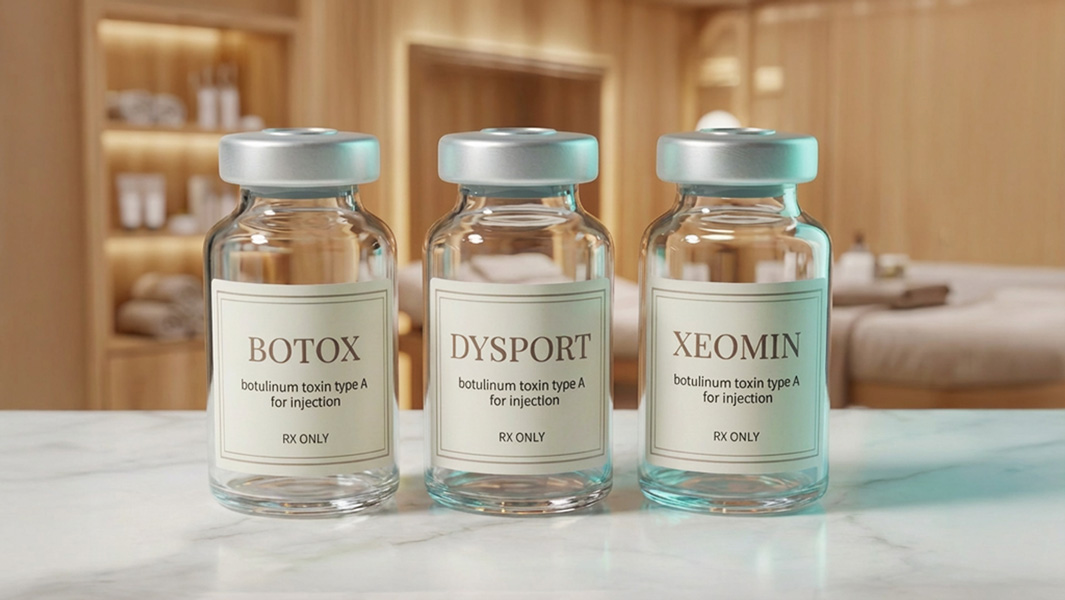


People use “Botox” the way people say “Kleenex”—as a catch-all for any wrinkle relaxer. But Botox, Dysport, and Xeomin are three distinct products, and the differences between them are real enough to affect your results.
Educational content only. If you have questions about which neurotoxin is right for your anatomy and goals, consult a board-certified provider before booking treatment.
Quick Definitions
Neurotoxin / Neuromodulator / Wrinkle Relaxer = the category. All three products belong to it.
Botox = onabotulinumtoxinA, made by AbbVie/Allergan. FDA cosmetic approval: 2002. [1]
Dysport = abobotulinumtoxinA, made by Ipsen. FDA cosmetic approval: 2009. [2]
Xeomin = incobotulinumtoxinA, made by Merz. FDA cosmetic approval: 2011. The only one with no complexing proteins. [3]
Mini takeaway
- Same active ingredient (botulinum toxin type A), different formulations
- “More units” doesn’t mean better — Dysport is dosed at roughly a 3:1 ratio to Botox and Xeomin
- The best neurotoxin is the one that fits your treatment area, muscle activity, and medical history
What They Have in Common
All three temporarily relax the specific muscles that create expression lines. They work by blocking the nerve signal that tells a muscle to contract — when the muscle can’t contract, the overlying skin stops creasing. [4]
The wrinkles they treat best are dynamic wrinkles — lines that appear with movement: crow’s feet from squinting, “11s” between the brows from frowning, horizontal forehead lines from raising your eyebrows. They’re not the right tool for static lines (the ones visible at rest) or volume loss, which is where dermal fillers come in.
All three are FDA-approved, require no downtime, and last roughly 3–4 months. The treatment itself is quick; the assessment that precedes it — reading your muscle movement, mapping injection points, dialing in the right product and dose for your face — is where the expertise lives. [4]
At a Glance: How They Compare
If you prefer to see the differences side-by-side, here is a simplified breakdown:
| Botox | Dysport | Xeomin | |
|---|---|---|---|
| FDA cosmetic approval | 2002 | 2009 | 2011 |
| Complexing proteins | Yes | Yes | No — pure formulation |
| Molecular weight | ~900 kDa | ~300–500 kDa | ~150 kDa |
| Spread after injection | Penny-sized | Quarter-sized | Dime-sized |
| Results visible | 3–7 days | 2–3 days | 4–5 days |
| Full effect | ~2 weeks | ~2 weeks | ~2 weeks |
| Typical duration | 3–4 months | 3–4 months | 3–4 months |
| Unit conversion | 1:1 with Xeomin | 3 units ≈ 1 Botox unit | 1:1 with Botox |
| Refrigeration required | Yes | Yes | No |
| Antibody resistance risk | Moderate | Moderate | Lowest known |
| Best for | Targeted areas (crow’s feet, glabellar) | Broader areas (forehead) | Sensitive skin, long-term use, prior resistance |
| Allergen note | Contains albumin | Contains egg/lactose proteins — avoid if allergic | Protein-free |
The Key Difference: What’s In the Vial
The active ingredient — botulinum toxin type A — is the same in all three. What differs is the rest of the formulation.
Botox
Botox contains the neurotoxin surrounded by complexing proteins, giving it a molecular weight of approximately 900 kDa. [5] Those proteins were originally thought to stabilize and protect the toxin, though their clinical significance in cosmetic dosing is still debated. What’s clear is that they influence how the product diffuses under the skin and how the immune system responds over time.
Dysport
Dysport also contains complexing proteins, but in a lighter configuration — a mixture of approximately 300 kDa and 500 kDa complexes. [5] This smaller molecular size is part of why Dysport spreads more readily once injected. It also contains lactose and trace cow’s milk proteins, which matters if you have a dairy or egg allergy. [4]
Xeomin
Xeomin is the stripped-down version — botulinum toxin type A with no accessory proteins at all, giving it a molecular weight of approximately 150 kDa. [5] It’s often called the “naked” injectable for this reason. The absence of proteins means it doesn’t require refrigeration, carries the lowest known antibody formation risk, and is the only option for patients who’ve developed resistance to the other two. [3]
Why the Formulation Differences Matter
Spread and precision
The protein content directly affects how far each product migrates from the injection point.
Xeomin spreads the least — roughly dime-sized. Botox spreads slightly more — about penny-sized. Dysport spreads the most — approximately quarter-sized. [4]
This isn’t a flaw in any of them — it’s a design characteristic that makes each one more suited to certain areas. Dysport’s wider diffusion is an advantage when treating a large muscle like the forehead; it can cover more territory with fewer injections. Botox and Xeomin’s more contained spread is an advantage for precision work around the eyes, where you don’t want product drifting toward the levator muscle (which keeps the eyelid elevated). [5]
Onset
Most patients notice Dysport working first — visible results often appear within 2–3 days. Botox typically takes 3–7 days for visible change. Xeomin lands in the middle at around 4–5 days. [6] All three reach their full effect by 2 weeks, which is why providers schedule follow-up checks at that point rather than sooner.
Duration
All three average 3–4 months. Individual variation is significant — your metabolism, muscle strength, stress levels, and how much you exercise can all affect how quickly results fade. [4] Some patients consistently get 5 months from one product; others wear through any neurotoxin in 10 weeks. Tracking this over a few treatment cycles tells you more than any general guideline.
Antibody resistance
This is the factor most patients don’t hear about — and it matters most for long-term users.
The complexing proteins in Botox and Dysport can trigger an immune response. Over repeated treatments, some patients develop neutralizing antibodies — proteins the body produces to block the toxin’s effect. When this happens, treatment results become weaker, shorter, or stop working entirely. [7]
A cross-sectional study published in Neurology found annual neutralizing antibody formation rates of 1–2% in patients using protein-containing neurotoxins — meaning that after ten or more years of regular treatment, more than 10% of patients may experience partial or complete resistance. [8]
Xeomin’s protein-free formulation bypasses this problem. In studies of patients treated exclusively with Xeomin, no neutralizing antibody induction has been reported. For patients who’ve already developed resistance to Botox or Dysport, switching to Xeomin often restores normal treatment response. [3]
Dosing: Units Are Not the Same
One of the most confusing parts of comparing neurotoxins is that they’re measured in different units — and those units are not interchangeable.
The standard conversion is: 1 unit of Botox ≈ 1 unit of Xeomin ≈ 3 units of Dysport. [6]
This means if your provider tells you Dysport is cheaper per unit, they’re right — but you’ll need approximately three times as many units to treat the same area. The final treatment cost often ends up comparable.
Typical units by treatment area:
| Treatment Area | Botox | Dysport | Xeomin |
|---|---|---|---|
| Crow’s feet | 10–15 units | 30–45 units | 10–20 units |
| Forehead lines | 10–15 units | 30–45 units | 10–20 units |
| Glabellar / “11” lines | 20–30 units | 50–70 units | 20–30 units |
These are general ranges. Your actual units will depend on your muscle mass, the depth of the lines, and your provider’s technique. Never price-compare neurotoxins by per-unit cost alone — always look at the projected total units for your specific treatment.
Which One Is Right for You?
There’s no universally “best” neurotoxin. The right choice depends on your anatomy, the area being treated, your allergy history, and how your body has responded to previous treatments.
Botox makes the most sense if:
- You’re new to injectables and prefer the most extensively studied option
- You’re treating crow’s feet or other areas that require contained, precise placement
- You want a treatment with the broadest FDA-approved indications [1]
Dysport makes the most sense if:
- Your primary concern is the forehead or areas where broader coverage is an advantage
- You have strong, active muscles and need a product with good diffusion to soften larger areas [6]
- You want faster initial results — useful if you’re working around a specific event
- You don’t have egg or dairy protein allergies
Xeomin makes the most sense if:
- You have sensitive skin or known allergies to the proteins in Botox or Dysport
- You’ve noticed your results getting shorter or weaker with Botox or Dysport over time
- You’re planning long-term neurotoxin use and want to minimize antibody formation risk
- You want the purest formulation available [3]
Can you use more than one?
Yes. Some providers use different neurotoxins in different areas of the same treatment session — for example, Dysport for a large forehead and Botox around the eyes. It’s less common but not unusual.
Can you switch between them?
Yes, safely. Most providers recommend waiting until your current treatment has fully worn off before switching products. Switching is also the standard approach when someone develops resistance to one neurotoxin. [6]
What to Expect: Before, During, and After
Before your appointment
Avoid blood-thinning medications (aspirin, ibuprofen, fish oil) for about a week before treatment to minimize bruising risk. Skip alcohol for 24 hours before. Arrive with a clean face — no makeup on the treatment area.
During treatment
Your provider will assess your muscle movement, mark the injection points, and use a very fine needle to inject small amounts into targeted muscles. The whole process usually takes 10–15 minutes. You’ll feel a small pinch at each injection site. Most people find it very manageable; if you’re concerned, ask your provider about a topical numbing option.
After treatment
- Avoid rubbing or massaging the treated area for 4 hours
- Skip strenuous exercise and extreme heat (saunas, hot yoga) for 24 hours
- Stay upright for the first few hours — no lying face-down
- Don’t panic if nothing is visible in the first 48 hours — onset takes time
- Return for a two-week follow-up so your provider can assess results and add units if needed [4]
Mistakes That Make Results Worse
Rubbing the treated area. The most common post-treatment mistake. Rubbing can cause the neurotoxin to migrate to unintended muscles.
Exercising too soon. Increased blood flow in the first 24 hours can disperse the product before it’s fully settled.
Skipping the two-week follow-up. This is where underdosed areas get corrected. Skipping it means accepting incomplete results.
Choosing a provider based on price alone. Neurotoxin placement is the primary driver of results — technique, anatomy knowledge, and product selection matter far more than which brand is in the vial.
Expecting static lines to disappear. Neurotoxins relax muscles. They don’t fill volume or remodel skin texture. Lines that are visible at rest — especially deep ones — may need a combination approach including fillers or resurfacing.
Waiting until results are completely gone before re-treating. Treating on a consistent schedule (every 3–4 months) before the muscle regains full strength tends to produce better long-term results than waiting until wrinkles fully return.
FAQ
Is Dysport better than Botox?
Does Botox or Dysport last longer?
Why is Xeomin less well-known?
Can I develop resistance to neurotoxins?
Will I look "frozen"?
How long after treatment until I see results?
Can neurotoxins be combined with fillers?
Recap & Next Step
- Botox, Dysport, and Xeomin all contain botulinum toxin type A and work the same way — the differences are in formulation, spread, onset, and long-term antibody risk
- Dysport spreads most and works fastest — best for larger areas and strong muscles
- Botox is the most established with the broadest FDA approvals — best for targeted precision work
- Xeomin is protein-free with the lowest antibody risk — best for sensitive skin, long-term users, or anyone who’s developed resistance
- Units are not interchangeable — compare total treatment cost, not per-unit price
If you want a provider to assess your specific anatomy and recommend the right neurotoxin and dosing for your face, book a consultation at Bogat Aesthetics & Wellness in Hallandale Beach. Our team works with all three neurotoxins and will help you understand exactly what to expect before treatment starts.
Glossary
Neurotoxin / Neuromodulator
An injectable protein that temporarily blocks nerve signals to muscles, reducing their ability to contract. Used in aesthetics to soften dynamic wrinkles.
Dynamic wrinkles
Lines that appear or deepen with facial movement — frowning, squinting, raising the eyebrows. Neurotoxins address these directly.
Static wrinkles
Lines visible at rest, regardless of muscle movement. Often require fillers or resurfacing rather than (or in addition to) neurotoxins.
Complexing proteins / Accessory proteins
Non-active proteins that surround the botulinum toxin molecule in Botox and Dysport. They affect how the product spreads and can stimulate immune responses over time. Xeomin contains none.
Neutralizing antibodies
Immune proteins the body produces in response to foreign proteins. When they form against a neurotoxin, they can reduce or eliminate treatment effectiveness.
Diffusion / Spread
How far a product migrates from the injection site. Higher diffusion (Dysport) covers more area; lower diffusion (Xeomin) allows more precision.
Unit
A measure of neurotoxin potency — but units are product-specific. One Botox unit ≠ one Dysport unit. The standard conversion is approximately 1 Botox unit = 3 Dysport units.
References
[1] AbbVie — BOTOX Cosmetic 20-year FDA approval announcement https://news.abbvie.com/2022-04-13-BOTOX-R-Cosmetic-onabotulinumtoxinA-Celebrates-20-Years-Since-First-U-S-FDA-Approval
[2] Drugs.com — Dysport FDA approval history https://www.drugs.com/history/dysport.html
[3] Allure Medical — Antibodies and resistance to neurotoxins https://www.alluremedical.com/blog/cosmetics/antibodies-and-resistance-neurotoxins/
[4] American Board of Cosmetic Surgery — Guide to Botox-type injectables https://www.americanboardcosmeticsurgery.org/procedure-learning-center/non-surgical/guide-botox-type-injectables/
[5] IAPAM — Xeomin vs. Botox vs. Dysport https://iapam.com/xeomin-vs-botox-vs-dysport
[6] LA Beauty Skin Center — Botox vs. Dysport vs. Xeomin comparison https://labeautyskincenter.com/wrinkles-no-more-botox-vs-dysport-vs-xeomin-whats-the-difference/
[7] PMC — Neutralizing antibodies to botulinum neurotoxin type A in aesthetic medicine https://pmc.ncbi.nlm.nih.gov/articles/PMC3872090/
[8] Neurology — High prevalence of neutralizing antibodies after long-term botulinum neurotoxin therapy https://www.neurology.org/doi/10.1212/WNL.0000000000006688
[9] Drugs.com — Dysport vs. Botox key differences and effectiveness https://www.drugs.com/medical-answers/dysport-botox-difference-3124590/